Here are some photos from one of my trips in 2009... you may click on the slideshow to open the album in a new window/tab. Regular content will resume on next Friday. Thank you for visiting!
Get link
Facebook
X
Pinterest
Email
Other Apps
Comments
Anonymous said…
I like this set of photos a lot. I have been working on projects related to the British trains and never been to there before.
The train of this week is a locomotive unveiled in 2009 by the BNSF Railway. Instead of using conventional diesel fuel, it is powered by hydrogen fuel cells (I have very limited knowledge in this area, so please feel free to comment on this post if you are interested in and familiar with the topic of hydrogen fuel cells). It is called the HH20B, a hydrogen-hybrid switcher locmotive based on the GG20B Green Goat diesel-hybrid switcher built by Railpower Technologies Corp. of Brossard, Quebec (acquired by R.J. Corman Railroad Group of Nicholasville, Kentucky in 2009). The GG20B is powered by a 300 hp 4-stroke Caterpillar diesel-engine and a battery pack with a combined tractive output of 2,000 hp. On the HH20B, diesel engine is replaced by hydrogen fuel cells. Hydrogen storage is in a set of tanks installed on top of the long hood of the locomotive in a heavily vented enclosure, above the batteries. The BNSF Railway displaying its low- and ul...
Last week, we've identified the Janney coupler and briefly looked at its elegant design. This week, let's, again, very briefly, look at the different types of Janney coupler that are widely used today. I will only talk about the head of the coupler, and ignore anything that the general public may need to trespass onto railroad property and get in a unsafe situation in order to have a good look at. As far as coupler heads are concerned, there are 3 types in used today. Type E, F, and H. Types E and F are used on freight, and H used on passenger equipment. Since the withdrawal of passenger service in North America by private railroads, the Type H standard is no longer maintained by the Association of American Railroads, a trade group formed of major freight railroads, but is under the control of the APTA, the American Public Transportation Association. Now let me introduce another term, slack. Slack is an allowed gap between two coupled up couplers. In other words, when most ...
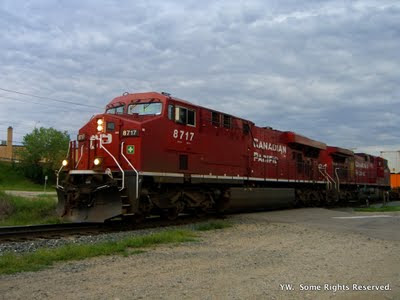
The ES44AC (successor of the AC4400CW) is a member of the family of GE's latest and greatest diesel-electric freight locomotives, the Evolution Series . Other locomotives in the Evolution Series include ES40DC, ES44DC, ES44C4 for the domestic market and ES44ACi (Kazakhstan), ES59ACi (China), and ES44DCi (Australia) for export. The direct competitor of the ES44AC is the SD70ACe developed by Electro Motive Diesel (EMD). The name ES44AC can be simply decoded as E volution S eries 4 , 4 00 horsepower AC traction (this naming scheme does not apply to EMD products or the ES59ACi which actually outputs 6,250 horsepower). However, unlike electric locomotives, the rated power of diesel-electric locomotives are measured at the prime mover (i.e. the diesel engine), not at the traction motors. The Evolution Series were developed to meet the stricter EPA Tier 2 emission standards. These locomotives use the GEVO prime movers instead of the FDL prime movers used on th...


Comments