So I did some digging on Wikipedia (initially quite aimlessly actually) on the relatively recent comeback of multi-engined diesel locomotives. Actually I didn't realize the popularity of multi-engined, especially twin engined diesel locomotives, back in the days until literally a couple of hours ago. It all makes sense though. When you need big power out of engines in an era where they just can't produce that much, you jam more of them in.
Not a bad looking little thing at all
This locomotive I'm writing about today is quite an oldie and is apparently closely related to a German diesel hydraulic locomotive of the same era. She's called the Class 42 and she has nothing to do with the more popular Class 43 that we all cherish.
This is one of the 2 preserved units. Interestingly they have inboard bearings like our LRC and Amfleet cars
There have been 2 batches of Class 42s, both built by British Railways Swindon Works between 1958 and 1961. They differ by engine. Earlier units had Maybach engines coupled to Mekydro hydraulic transmissions and later units had MAN. All the engine choices pump out around 1 100 horsepower. More information, including some geeky stuff about this locomotive can, of course, be found on her dedicated Wikipedia page. The Class 42 locomotives were given the nickname Warship Class, due to the fact that most locomotives in this were named after Royal Navy vessels.
Oh and when I said closely related to a German locomotive, I meant pretty much manufactured under license. Of course the footprint of the loco would have been shrunken down to fit the British loading gauge.
These are nice locomotives. I'm told they were very unpopular at first because of their German origins (this wasn't that long after the war) so naming them after British warships was a way to make them more 'patriotic' so people would accept them. It worked, apparently and they became extremely popular amongst railfans.
There are a few of the German locomotives still about, some are preserved and some owned by private freight operators.
The train of this week is a locomotive unveiled in 2009 by the BNSF Railway. Instead of using conventional diesel fuel, it is powered by hydrogen fuel cells (I have very limited knowledge in this area, so please feel free to comment on this post if you are interested in and familiar with the topic of hydrogen fuel cells). It is called the HH20B, a hydrogen-hybrid switcher locmotive based on the GG20B Green Goat diesel-hybrid switcher built by Railpower Technologies Corp. of Brossard, Quebec (acquired by R.J. Corman Railroad Group of Nicholasville, Kentucky in 2009). The GG20B is powered by a 300 hp 4-stroke Caterpillar diesel-engine and a battery pack with a combined tractive output of 2,000 hp. On the HH20B, diesel engine is replaced by hydrogen fuel cells. Hydrogen storage is in a set of tanks installed on top of the long hood of the locomotive in a heavily vented enclosure, above the batteries. The BNSF Railway displaying its low- and ul...
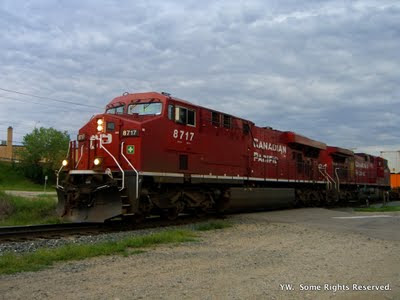
The ES44AC (successor of the AC4400CW) is a member of the family of GE's latest and greatest diesel-electric freight locomotives, the Evolution Series . Other locomotives in the Evolution Series include ES40DC, ES44DC, ES44C4 for the domestic market and ES44ACi (Kazakhstan), ES59ACi (China), and ES44DCi (Australia) for export. The direct competitor of the ES44AC is the SD70ACe developed by Electro Motive Diesel (EMD). The name ES44AC can be simply decoded as E volution S eries 4 , 4 00 horsepower AC traction (this naming scheme does not apply to EMD products or the ES59ACi which actually outputs 6,250 horsepower). However, unlike electric locomotives, the rated power of diesel-electric locomotives are measured at the prime mover (i.e. the diesel engine), not at the traction motors. The Evolution Series were developed to meet the stricter EPA Tier 2 emission standards. These locomotives use the GEVO prime movers instead of the FDL prime movers used on th...
What makes most trains, trains, is the fact that locomotives and cars are interconnected by some mechanism (of course they no longer had to be since the introduction of the rail diesel car) that allow them to move along the railroad tracks simultaneously. Before I go further, I wish to introduce, very briefly, buff and draft forces. Two cars are in buff when they push against and are in draft when they pull against each other. A little bit on history: at the very beginning, this mechanism that connects cars together are made up of separate components that deal with buff and draft forces individually. The link and hook take care of draft forces, and buffers (they look like pancakes sticking out the ends of trains as seen in Thomas the Tank Engine) deal with buff forces. Although this system works well once the coupling is complete, which is why it is still in use in many parts of the world, there are many disadvantages to this primitive coupling system that make it unacceptable ...



Comments
There are a few of the German locomotives still about, some are preserved and some owned by private freight operators.