Posts

Time for a change (and more interesting things around trains!)

I've started a new blog, maybe something of an expansion to this one, where I'll do more than linking and summarizing things from Wikipedia most of the time. At the time this blog started, the name might have suited the purpose just fine, but over time, I found it a little restricting. Maybe it's because I have OCD tendencies or something, it bugs me to not rigidly posting about some nerdy train stuff every week (although I had missed posts many a time), and slowly the fun of blogging had been eroding away with it. Anyway, enough of making excuses for myself. Here goes the new blog, called Wenige Minuten Später , a name that accurately depicts my experiences with the Deutschebahn over the past two years of living in Germany. And as my stay here draws to an end, this blog will hopefully serve as a reminder of the fun-filled, semi-carefree time of my grad school days. So what if the posts might be a few minutes late?

DB Class 440/1440

Image
At some point in the past, as I was daydreaming about the Scandinavian skies, I wrote about the Alstom Coradia Nordic . They became quite active in the snowy north, having replaced a variety of vintage rolling stocks across a wide spectrum of services. Little did I know. They had cousins, the Coradia Continental, who made their way south to Germany. Some of them even settled right in my current backyard, humbly serving on the busy S-Bahn Rhein-Ruhr. Von Muellean in der Wikipedia auf Deutsch (Andreas Müller) - Eigenes Werk des ursprünglichen Hochladers, CC BY-SA 3.0 de , Link Von IPRobin - Eigenes Werk , CC-BY-SA 4.0 , Link These electric multiple-units are known as the Class 440 (newer versions are called the Class 1440). They had been roaming far and wide in the Vaterland since the late 2000s. Having a top authorized speed of 100 mph, these trainsets not only could operate in frequent-stop suburban commutes, they are fully capable of running as RegionalBahn or RegionalExpre...

British Rail Class 195

What I’m blogging about today, doesn’t exactly exist in real life yet, but it’s been a while since the last time I wrote about anything British. It was just on the news , by the way. Don’t know if the little Pacer DMUs ring a bell to anyone who reads this blog, but they are literally busses on rails (bus frame plus four steel wheels). They are interesting to see, and ride once in a while. They sound like an old bus, rattle like an old bus, and the experience is quite unique. Sadly, or maybe not so to people who might be stuck with them on their commute, they are about to be replaced by new Spanish built DMUs that will enter service when Arriva (pronounced Deutschebahn) takes over the Northern franchise. The new DMU is called the Class 195, and its production has officially commenced this week. For that reason, there’s only this artist rendering which I can't share with you (but here it is in Wikipedia), but I’m sure pictures will surface when the time comes. These trains are e...

DB InterCity 2

Image
The IC2 is still considered a rare sight by me, unless I camp outside a station where they stop. They are meant to be a kind of an intermediary solution to lines where the maximum authorized speed does not warrant the use of one of the shiny new ICE4 s that are to replace some existing InterCity trains. Essentially, the IC2 is an upgraded RegionalExpress Twindexx Vario trainset with an inverted long-distance colour scheme. They even have the same Class 146 locomotives on one end. As such, they do not come equipped with a bistro car. Food and beverages are served from trolleys, airline style (and maybe some people would rather prefer not to leave their seat). Von Falk2 - Eigenes Werk , CC-BY-SA 4.0 , Link The speed of these trainsets remains the same as their regional cousins, at 99 mph, down from 124 mph with the regular InterCity services. More sets will gradually come online throughout the next few years, as Bombardier irons some bugs out in the meantime (read more here on ...

SD70ACu

Image
After the post on the shiny rebuilt GE road power, it's only fair to have a look into what Progress Rail has to offer on their side of the table. I'm using the company's recently-changed, formal name of course. For those who are not up-to-date on the current state of North American railroading affairs, Progress Rail is the company (owned by Caterpillar) that purchased EMD a few years ago. The SD90MAC was arguably the biggest gong show in EMD's recent memory. It happened at a time when they were comfortably resting on their laurels, unaware the fateful changes that were about to occur in the locomotive market in the not-so-distant future (they got beaten badly by GE). What was supposed to be one of the most remarkable locomotives whose presence is to grace the mainlines in modern history, turned out to be an utter disaster (I'll redirect further readings to Wikipedia). As a result, today, the number of SD90s still in operation on a Class 1 Railroad is, if not id...

Siemens-Düwag U2

Image
By Koman90 - Own work , CC BY-SA 3.0 , Link Sometimes I feel like I'm running out of things to write about on this blog, but maybe that's because there are really too many things out there. It's hard to decide, and I can't keep up lately. One of the very first posts on this blog I started quite a few years ago was about the C-Train. For those of you who don't know, that's the name given to the Light Rail Transit system in the Canadian city of Calgary, Alberta, a place I reluctantly (at first, anyway) called home due to its lack of public transit infrastructure (still true today, but hell, we've got oil and pickup trucks) despite having a population of over one million. Though, never had I known was that the C-Train would become one of this meaningless but nonetheless interesting coincidence in my life. You see, the oldest of the C-Trains are the Siemens-Düwag U2. They were built in the city of Düsseldorf, a few stops down the line on the RegionalExpress ...

GE AC44C6M

Image
North American railroads are no strangers to rebuilding older locomotives to help lower cost. Unlike many parts of the world, the adhesion-limited operating environment often means that our locomotives are heavier and moderately powered. At one point in history, First Class Railroads have converged onto the ideal mainline locomotive, a six-axle unit having about 4,400 hp, and weighing at about 400,000 lbs. By Nstrainman1006 - Taking a photo. Previously published: YYYY-MM-DD, CC BY-SA 4.0 , Link In the 1990s, amid the market dominated by General Motors, the microprocessor-controlled Dash 9 Series was the revolution General Electric needed that kick-started their rise to the top. Within the series, there was the C40-9W , a limited-power edition of the mainstream C44-9W , specifically conceived for the Norfolk Southern. Starting in late 2013, these units were converted to the C44, and then two years later, some started further upgrades to, eventually, become the AC44C6M. Compa...

Another lazy week (but there are steam engines!)

Image
Last week, I linked a couple of clips that I posted on Instagram from the Fototag at the local museum. I actually have more footage, and I briefly patched them together in iMovie, and here it is, in one video.

A Special Museum on a Special Day

Image
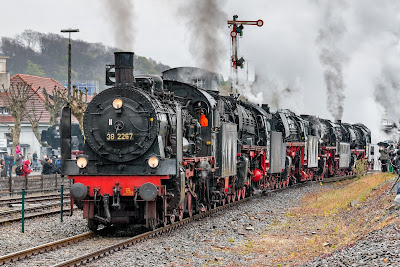
It was a long weekend here in Germany last week, and the Eisenbahnmuseum Bochum put on a good show to celebrate its 40-year history. Well, I confess, of course I hadn't found out about any of it until it was almost too late. Click here to view the entire album In the spirits of the East Meets West theme, many locomotives from other railway museums across Germany joined their brethren in Bochum-Dahlhausen. I attended on the extra-special day, May 1, der Fototag (Photo Day), where locomotives paraded down the track, providing lots of photo ops for foamers of all sizes and shapes. Of course, the typical Bochum-weather did not bother to show us any blue sky, but boy, do those steam locomotives look beautiful in the rain. Three pairs of diesel and three pairs of steam locomotives participated in two rounds of parades throughout the day. Each pair shared performed similar duties for the Deutsche Reichsbahn and Deutsche Bundesbahn. First was a presentation in their individualit...

MPI MP32PH-Q

Image
Let me come back to my own side of the pond for now and write about a locomotive in the warm parts of the continents. The slight mystery surrounding them intrigues me a little, but I'm sure it's nothing a seasoned railfan can't educate me on. I shall begin by talking a little about the previous life or lives of what are known today as the MP32PH-Q. Unlike its brethren MPXpress locomotives, it is a direct re-iteration of its ancestors from MPI's Morrison-Knudsen days. By Artystyk386 - Own work , CC BY-SA 3.0 , Link When MK Rail was still a thing, they were known for rebuilding locomotives of other origins. Many transit agencies enlisted their service to provide spin-offs of the proven EMD GP38 and GP40 locomotives. Known as the GP40WH-2 in their previous life under MARC (Maryland Area Regional Commuter), the MP32PH-Q already packed lots of mileage hauling passengers under their belt. These days, they work down south, serving in Florida and soaking up all the ...

DB Class 420

Image
Shall we continue with the retro theme of the recent weeks? The DB Class 420 EMU screamed 1970s the very first time I laid eyes on it (not in a bad way). It's not bad looking by any means. In fact, it is actually refreshing to see something relatively old among all the shiny modern passenger equipment around me in the NRW. By Manfred Kopka - Own work , CC BY-SA 4.0 , Link Like the Class 111 locomotive featured last week, the Class 420 was developed by the Deutsche Bundesbahn for the S-Bahn service. It, however, was assigned to the S-Bahn networks of Munich, Stuttgart, and Frankfurt am Main instead. Each trainset consists of 3 cars. As usual, they can doubled up and work in multiple units. Like older subway cars, these mass-transit mainline trainsets do not have through gangways between cars. If you were unlucky, you'd be stuck in a very packed car, while the next one could be nearly empty. By Michael Bienick - Own work , CC BY-SA 3.0 , Link By Rolf Heinrich, Köln , C...

DB Class 111

Image
Beautifully made videos by  TheKnaeggebrot  in stunning Southern Bavaria Aha, it's that time of the week, and I haven't forgotten about this blog this time around (which is a little sad, really). Let me bring your attention to the DB Class 111 , another locomotive from the Deutsche Bundesbahn days. It seems to be making a comeback? (Not sure if that's really the case, but there seems to be more and more of them on RegionalExpress trains around the area I live in, and even on some S-Bahn trains). By Lars Steffens - Flickr : Baureihe 111 , CC BY-SA 2.0 , Link Built from the mid-70s, throughout to the mid-80s, the Class 111 was originally designed for regional trains and the then new S-Bahn Rhein-Ruhr. Capability for InterCity service was added in the early 1980s, with an increase of maximum permissible speed from 93 to 100 mph. Like many locomotives of the same era, the Class 111 was built by a consortium of builders, consisting of Krauss-Maffei, Henschel, Krupp, S...

DB Class 120

Image
The Class 120 is an inconspicuous looking locomotive (in today's standard, anyway). It occasionally, casually drifts across the rails right in front of my eyes, almost blending into the background, hardly noticeable at all. I would've probably have never thought much of it, until now. The amount of information the English Wikipedia page has provided is a bit of a pity. Luckily, though, it is 2017, and there's Google Translate (well, hopefully at least one version of me in some alternate universe is actually learning German). There is no way this post can contain (nor should it) all the wealth of information found on the locomotive's German Wikipedia page. Here, I'll just show off a few what I think are highlights. Von Benedikt Dohmen ( User:Benedictus ), Archiv-Nr. 63/28 - Eigenes Werk , CC BY-SA 3.0 , Link So beneath the underwhelming looks of the Class 120 is one of the first production three-phase AC locomotives equipped with regenerative braking. It w...

AVE Class 100

Image
I slacked off last week again, didn’t I. Anyhow, let’s continue with the Paella theme and check out the AVE Class 100. As you may recall, AVE stands for Alta Velocidad Española, the service name used by the Spanish national passenger operator, Renfe, on its high-speed trains. A Class 100 on the Madrid to Barcelona high-speed line The story here sounds similar to some of the other countries that got into the high-speed rail business by importing in the later parts of the 20th century. The Class 100, like the first KTX (Korea Train eXpress), are derived from the iconic TGV Atlantique. Like the KTX, the styling of the AVE Class 100 has been modified slightly, resulting in a more rounded nose. Nonetheless, it does not require any effort to spot the family resemblance. By SeeSchloss - Own work , CC BY-SA 2.5 , Link The trains went into service in 1992, after the first standard gauge high-speed line was completed in Spain from Madrid to Seville (it was almost going to be Iberian ...

AVE Class 103

Image
A very well made video by YouTube user Mikhail@Novgorod showing various types equipment on the Córdoba to Málaga High-Speed Line I have already written about some of the  Siemens Velaro family of high-speed trains in earlier posts, but I wanted to dedicate this one to the Velaro E (for España), or more commonly known as the AVE (Alta Velocidad Española or Spanish High Speed) Class 103 . A Class 103 towards Barcelona on the outskirts of Madrid On the outside, the Velaro E looks almost identical to the ICE 3 , which is a product jointly developed by a number of companies in Germany. However, due to licensing issues, Siemens re-developed components on the ICE 3 it did not make, thus completing the Velaro platform of high-speed trains. The Velaro E also received an upgrade in the traction department, in order to cope with the demand for higher acceleration and maximum speed by Renfe (the Spanish national railway company). As a result, the AVE Class 103 is authorized for ser...

Renfe Class 446 and 447

Image
I've had the fortune to go on yet another getaway to the not-so-distant country of Spain, where conventional lines use the Iberian gauge of 5' 5-21/32''. Although it was devoid of any long-distance train trips, I still had the pleasure of experiencing the suburban Cercanías service in Madrid. The Class 446, De Hugh Llewelyn - 180 Uploaded by Oxyman , CC BY-SA 2.0 , Enlace The Renfe Series 446 and 447 make up a portion the current Cercanías fleet. Since they look almost identical from the outside, I'm lumping them together in this post. In reality, though, the two series differ considerably mechanically. The Class 447, De Jordi Verdugo - 447 doble en Vilajuïga , CC BY-SA 2.0 , Enlace In a nutshell, the Series 447 is lighter and faster. They have more modern electric motors that help them accelerate more rapidly (more details on Class 446  here and Class 447 here ). The two series are compatible in multiple-unit, if necessary, and up to 4 sets...

Tarka Line

Image
I went hiking in England in the past week. Although most of my intercity travel was made by coach bus (for budgetary and logistical reasons), being who I am, I still had to slip a train ride in there somewhere, didn't I. By Geof Sheppard - Own work , CC BY-SA 3.0 , Link What could be a more suitable way to end my hike than a train ride on the quaint and picturesque single track Tarka Line from Barnstaple to Exeter? In the gentle green hills of Devon, DMUs on this line traverse a scenic 40 miles along the Rivers Creedy, Yeo, and Taw. The Tarka Line got its name from Tarka the Otter , a local animal hero from a novel by the same name. It is part of what used to be the North Devon Railway between Bideford and Exeter. Today, the line terminates in Barnstaple . Barnstaple Station today consists of a sole platform and track. By Geni at the English language Wikipedia , CC BY-SA 3.0 , Link Barnstaple as a Junction Station in yesteryear. By Ben Brooksbank, CC BY-SA 2.0 , Li...

We Have a Lift Off

Image
By Hisagi - 投稿者自身による作品 , CC 表示-継承 4.0 , Link Hyperloop seems to be all the hype these days. Given the progress in its development, it's about time we can call it for what it is (as far as a "new" invention goes). I won't directly address it, however. Instead, here is another system, currently under construction, that will serve as a case study to the rest of the world on the mass adoption of maglev technology. CC BY-SA 3.0 , Link Formally called the Chūō Shinkansen , the new central mainline in Japan is fundamentally different than the high-speed lines that come before it. It utilizes the SCMaglev , or Super Condicting Magnetic-levitation, technology that has been under development since 1962. The SCMaglev uses one of the three principal implementations of magnetic levitation, called EDS , or Electro Dynamic Suspension. The other two consist of EMS (Electro Magmetic Suspension), used by Transrapid, and Inductrack System (Permanent Magnet Passive Suspension...

Hey there, IORE

Image
Between the Internet and the LKAB presentation at the Heavy Haul Conference in Calgary some five years ago, I've become no stranger to these iron ore trains of the Arctic Circle. I was quite excited to see a big train again It has been a while since I last laid my eyes on some AAR 100-ton trucks, although they were surrounded by otherwise unfamiliar equipment. Photos don't do the IORE justice when it comes to their incredible might. In person, they, even with just a single section, almost in a weird way, look really long. The City of Kiruna itself feels like a deja vu. Snow and mountains in the backdrop, fatally frigid temperatures, sizable, heavy freight trains, and a passenger depot that was moved out of the city centre (although for different reasons than we are used to in our neck of the woods), to the yard at the edge of town. Fortunately, Kiruna isn't very big. It takes less than half an hour to complete a leisurely walk downtown, and there is a bus that...

The Arctic Circle Train

Image
The night I was on the Arctic Circle Train, it felt more like an Asian tour bus than anything. I had no idea there would be so many Asian tourists in Stockholm and heading north all at the same time. Anyway. I boarded the train before it was overrun The train itself, a locomotive hauled night train with aging long-distance cars, feels more familiar than the typical futuristic European multiple units. There are the relatively large seats (no leg rests, unfortunately) and the 100 mph top speed, which we are more accustomed to on our side of the Atlantic. I would go as far as calling the Arctic Circle Train the Canadian (of course, minus the Skyline and observation cars) from another dimension. It comes from a world that looks and feels similar but sounds completely different. Oh, did I mention that almost the entire network in Sweden is also electrified? An intermediate stop somewhere, early morning on Boxing Day Ready to depart Kiruna towards Narvik in Norway